
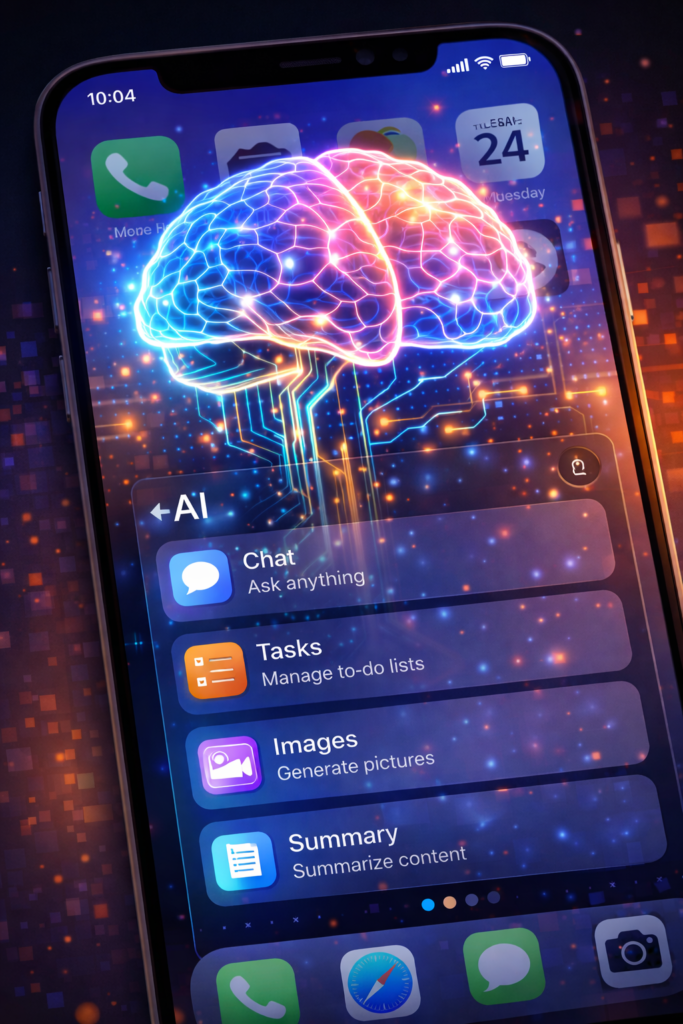
Apple, Google, and Samsung are increasingly shifting AI features from the cloud to the device itself, signaling a major change in how smartphones handle artificial intelligence.
Instead of sending everything to remote servers, more tasks are now processed directly on phones, tablets, and laptops.
What on-device AI means
On-device AI allows features like:
- Voice transcription
- Photo and video editing
- Smart replies and summaries
to run locally, without an internet connection. This makes AI faster, more reliable, and more private.
Why the shift is happening
There are three main reasons behind the move:
Performance: Local processing reduces latency and works even with poor connectivity.
Privacy: Sensitive data stays on the device instead of being sent to the cloud.
Cost: Processing on-device lowers server and infrastructure costs over time.
For companies operating at massive scale, those savings add up quickly.
How this affects users
For users, the benefits are mostly positive:
- Faster AI responses
- Better offline functionality
- Less data leaving your device
The trade-off is that advanced on-device AI requires newer hardware, which could widen the gap between older and newer devices.
The bigger picture
This isn’t a short-term experiment. Apple, Google, and Samsung are redesigning chips and software around local AI processing, making it a core part of future devices rather than an optional feature.
Cloud-based AI isn’t going away, but it’s no longer the default.
Final thoughts
On-device AI won’t feel revolutionary overnight, but it will quietly improve everyday tasks. As more features move off the cloud AI will feel faster, more private, and more integrated – less like a service, and more like a built-in capability.
And that’s exactly what these companies are betting on.