
Looking back at 2025, the gap between tech marketing promises and real-world delivery was wider than ever. Product launches came with breathless media coverage, influencer unboxings declaring everything “gamechanging,” and marketing claims that reality couldn’t possibly match.
Some products deserved the excitement. Others were exercises in manufactured enthusiasm, where the disconnect between promise and delivery made you wonder if anyone actually used the product before declaring it revolutionary. Here are the most overhyped tech products of 2025 — and why the reality didn’t match the marketing.
Vision Pro Competitors That Weren’t Ready
After Apple’s Vision Pro launched in early 2024, 2025 saw a flood of competitors rushing to market with their own mixed reality headsets. Meta, Samsung, and others promised Vision Pro experiences at a fraction of the price.
The hype: All the spatial computing goodness of Vision Pro without the $3,500 price tag. Mixed reality for the masses, finally making the technology accessible.
The reality: These headsets were cheaper for a reason. Lower resolution displays that made text hard to read for extended periods. Hand tracking that worked inconsistently and frustrated users. Comfort issues that made wearing them for more than 30 minutes painful. App ecosystems that launched sparse and stayed sparse.
The Meta Quest 3S and similar devices were fine for gaming and entertainment, but the productivity promises fell flat. Using virtual monitors for work sounded great in demos but caused eye strain and headaches in real use. The “killer apps” never materialized—mostly ports of existing apps that worked better on regular screens.
Why it was overhyped: The industry desperately wanted mixed reality to be ready for mainstream adoption. Every manufacturer racing to compete with Apple created a narrative that spatial computing was the next big thing happening right now. Reality check: the technology still isn’t there for most people’s daily workflows, regardless of price point.
AI Companion Devices (Humane AI Pin, Rabbit R1, and Others)
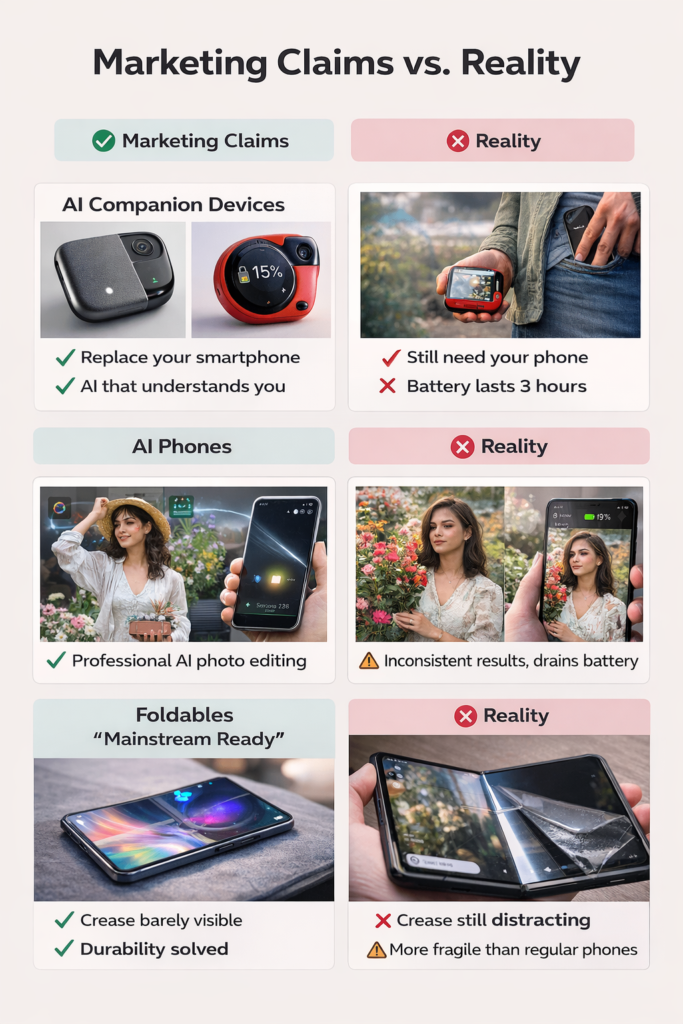
2025 was supposed to be the year of AI companion devices—standalone gadgets that would replace your smartphone for many tasks through AI-powered voice and visual interaction. The Humane AI Pin and Rabbit R1 led the charge with massive hype.
The hype: A post-smartphone future where AI assistants handle everything through natural conversation. No more scrolling through apps—just ask and receive. The next computing paradigm, here today.
The reality: These devices launched to enthusiastic reviews from early adopters and crashed within weeks in real-world use. Response times were slow. Accuracy was inconsistent. Battery life was abysmal—often lasting just a few hours. The AI frequently misunderstood requests or provided incorrect information.
Critically, they couldn’t actually replace smartphones for most tasks. You still needed your phone for messages, navigation, payments, and countless other daily functions. The AI companions became extra devices to charge and carry, not replacements for anything.
The Humane AI Pin’s projector interface was novel but impractical—hard to see in sunlight, awkward to use in public. The Rabbit R1’s “large action model” promised to complete tasks across apps but struggled with anything beyond simple requests.
Why it was overhyped: Because major tech figures hyped these products as revolutionary, and the media amplified those claims without sufficient skepticism. The concept of AI companions is compelling, but 2025’s implementations were barely functional minimum viable products masquerading as finished consumer devices.
The “AI Phone” Wave
Multiple manufacturers declared 2025 the year of the “AI phone,” with Google’s Pixel 9 series, Samsung’s Galaxy S24, and others promising revolutionary AI features built into the hardware.
The hype: Phones that understand you, anticipate your needs, edit photos like professionals, summarize everything, and fundamentally change how you interact with your device.
The reality: Most AI features were gimmicks people used once and forgot about. AI wallpaper generation was fun for a day. Circle to Search was occasionally useful but not transformative. AI photo editing produced inconsistent results that often looked worse than the originals.
The truly useful AI features—better voice typing, smarter autocorrect, improved spam filtering—were incremental improvements, not revolutionary changes. Battery life suffered because AI processing is power-hungry, and many people disabled features to extend battery life.
The on-device AI that was supposed to protect privacy while enabling powerful features was limited by phone hardware constraints. Most impressive AI capabilities still required cloud processing, undermining the privacy pitch.
Why it was overhyped: Because manufacturers needed a new selling point after years of incremental camera and processor improvements. “AI” became the marketing angle, even when the actual AI features were minor additions to otherwise standard smartphone upgrades.
Foldable Phones Declaring “Mainstream Ready”
Samsung, Google, and others declared 2025 the year foldables would finally go mainstream. Prices dropped slightly, durability supposedly improved, and software was more optimized.
The hype: Foldables are ready for everyone now. The crease is barely visible, the durability concerns are solved, and the software experience is finally mature.
The reality: The crease was still visible and distracting. Durability improved but foldables remained more fragile than regular phones—screen protectors peeling, hinges collecting dust, displays scratching more easily. Many users reported screen failures within the first year.
App support remained inconsistent. Many apps didn’t properly utilize the larger unfolded screen or handled the fold transition awkwardly. The promise of a tablet experience in your pocket delivered an awkward in-between size that wasn’t optimal for either phone or tablet use cases.
Battery life suffered because you’re essentially powering two displays. The phones were significantly thicker and heavier than regular flagships, making them less comfortable for one-handed use or carrying in pockets.
Why it was overhyped: Market saturation of regular smartphones pushed manufacturers to create new categories. Foldables are that category, but declaring them “mainstream ready” was aspirational marketing, not reality. They’re better than early versions but still niche devices for enthusiasts willing to accept compromises.
ChatGPT Wrappers Disguised as Revolutionary Apps
2025 saw an explosion of apps that were essentially ChatGPT with a specialized interface, marketed as revolutionary AI solutions for specific use cases—AI lawyers, AI doctors, AI financial advisors, AI therapists.
The hype: Specialized AI that understands your specific domain deeply. Professional-grade advice and assistance at a fraction of traditional costs.
The reality: Most were just ChatGPT or similar models with custom prompts and nice UI. They provided generic advice that often included disclaimers to “consult a real professional.” The “specialized” knowledge was surface-level at best, dangerous at worst.
Legal AI apps gave outdated or incorrect legal information. Health AI apps provided generic wellness advice while specifically disclaiming they weren’t medical advice. Financial AI apps gave investment suggestions with massive disclaimers about not being financial advice.
Many charged $10-30 monthly subscriptions for functionality you could get from ChatGPT Plus for $20/month across all domains. The specialization was marketing, not capability.
Why it was overhyped: The democratization of AI through ChatGPT’s API made it trivial to build domain-specific wrappers. Founders and investors convinced themselves (and tried to convince users) that a nice interface and domain-specific prompting constituted a revolutionary product. Users quickly realized they were paying premiums for minimal additional value.
“Smart” Home Devices That Barely Worked
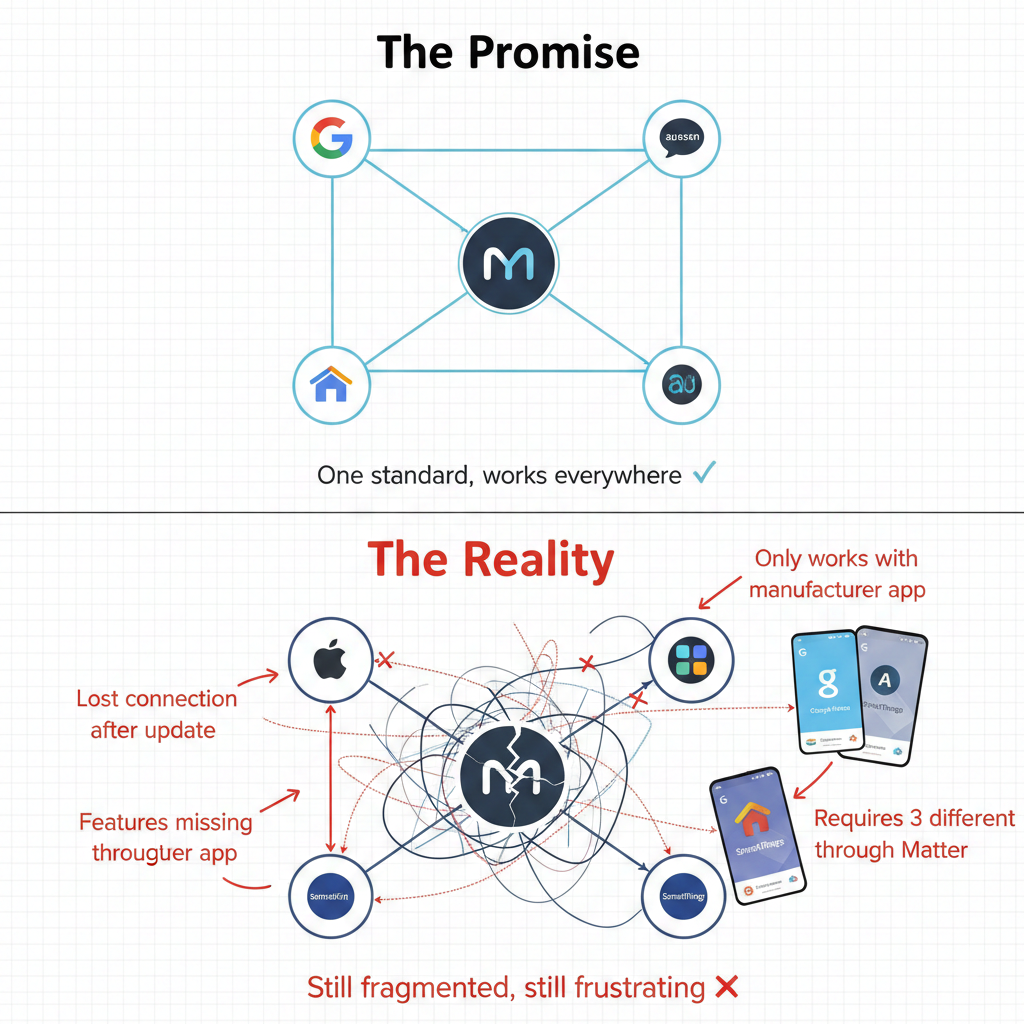
Matter was supposed to make smart home devices universally compatible in 2024. By 2025, manufacturers rushed Matter-compatible devices to market, promising seamless smart home integration across all platforms.
The hype: Finally, smart home devices that work together regardless of ecosystem. Buy any Matter device and it’ll work perfectly with Google Home, Apple HomeKit, Amazon Alexa, and everything else.
The reality: Matter support was incomplete and buggy. Devices lost connectivity frequently. Features that worked with one platform didn’t work with another. Updates broke compatibility that previously worked. Setup remained complicated and frustrating.
Many devices advertised as “Matter compatible” only supported a subset of features through Matter. Full functionality required manufacturer-specific apps and ecosystems, defeating the entire purpose.
The promised interoperability existed in theory but failed in practice. Users still ended up locked into specific ecosystems and dealing with multiple apps to control their smart home.
Why it was overhyped: Because the industry desperately needed Matter to succeed and collectively pretended it was ready when it wasn’t. Manufacturers rushed half-baked implementations to market to claim “Matter support” in marketing materials, regardless of actual functionality.
The Pattern Behind 2025’s Hype
Looking across the year’s most overhyped products, clear patterns emerged:
“AI-powered” justified everything. Adding AI to any product became the excuse for premium pricing and revolutionary claims, whether the AI actually improved the product or not.
Rush to market over readiness. Companies launched products before they were truly ready, banking on updates to fix problems later. This worked poorly when fundamental issues couldn’t be patched away.
Marketing to tech enthusiasts, not normal users. Products designed to impress in controlled demos and generate spec-sheet buzz, without considering daily real-world use by regular people.
Ecosystem lock-in disguised as features. “Seamless integration” often meant incompatibility with anything outside one company’s ecosystem, trapping users rather than serving them.
Overpromising privacy while undercutting it. Many products claimed to protect privacy through on-device AI while still requiring cloud processing for key features, undermining their own privacy pitch.
What Actually Delivered in 2025
Not everything was overhyped. Some products and technologies genuinely improved life without massive marketing campaigns:
USB-C becoming universal finally happened in 2025, making charging and data transfer simpler across all devices. This boring infrastructure improvement mattered more than most flashy launches.
Incremental phone improvements in cameras, battery life, and performance continued delivering real value without revolutionary claims.
WiFi 7 rollout started improving home network performance noticeably, especially in dense urban environments.
Boring software updates to existing platforms—better spam filtering, improved accessibility features, more efficient battery management—provided consistent value.
The pattern: genuinely useful innovation happened quietly through iteration and infrastructure improvements, while overhyped products got the attention through marketing spectacles.
The Lesson from 2025
The year taught us that the gap between marketing claims and product reality grows wider when technologies are still maturing. AI, mixed reality, and smart home ecosystems all need more development time, but competitive pressure pushes companies to launch prematurely and claim readiness that doesn’t exist.
For consumers, the lesson is clear: be skeptical of revolutionary claims, especially when they’re about “AI-powered” anything. Wait for real-world reviews from actual users, not just tech enthusiasts receiving free review units. The products worth buying solve specific problems you actually have, not theoretical problems marketing teams invented.
2025’s overhyped products weren’t scams—they were ambitious attempts to push technology forward that launched before they were ready. The gap between vision and execution was the problem, exacerbated by marketing that prioritized hype over honesty.
As we move into 2026, hopefully the industry learns to temper expectations and focus on delivering products that actually work well rather than marketing campaigns promising revolutionary experiences that can’t be delivered yet.